Modern and Contemporary Art in Latin America: Exhibition Project
Canonical Women
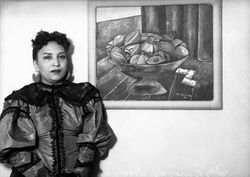
Women Artists Living in Latin America
 |  |  |
|---|---|---|
 |  |
Exhibition Concept
Our exhibition explores both commonalities and differences in the bodies of work of a group of women artists residing in Latin America during the 20th century: Frida Kahlo, Leonora Carrington, Remedios Varo, María Izqueirdo, and Tarsila do Amaral. Through this exhibition, we seek to contrast the varying historical, political, and social movements of the time that subsequently impacted the artistic practices of these women. Moreover, we hope to compare their reception of European modernism based on their varied levels of academic training in the arts, their travels, and their statuses within the areas they resided in, be it as natives or individuals living in exile.
Some were open to the Western canon and even channeled what they learned into their own artistic production, such as Remedios Varo channeling Surrealism and Tarsila do Amaral inspiring Anthropophagy based on her reception of European modernism. Others, however, rejected the ideologies of European avant-garde movements and were uncomfortable with associating themselves with figures of said movements, such as Frida Kahlo and Leonora Carrington. In spite of their differing opinions with respect to European modernism, all of these women share similar attributes, whereby their careers helped shape our present ideas of the specific movements they were either exposed to or participated in.
Frida Kahlo’s uniquely personal and autobiographical artistic style is one that particularly provides viewers with an in-depth look into the life of one person navigating life in Mexico City as a woman, painter, wife, and Mexican native. Similarly, although in a manner that encompassed Mexican women and culture more broadly, María Izquierdo creates artwork that explores the relationship of a woman to her culture and the social standards placed upon her. Meanwhile, upon her return from Europe, Tarsila do Amaral revolutionized the concept of a Brazilian modernity with her desire to create an artistic movement that was specific to her country. Finally, albeit living in Mexico for a large part of their lives, both Leonora Carrington and Remedios Varo immigrated there from different parts of Europe, thereby adopting artistic productions that engaged in dialogue between both European and Latin American modernism.
With a focus on artists living in Latin America and portraying the woman’s experience in the 20th century, this exhibition offers viewers a window into the various societal roles women either played, rejected, or transformed. Moreover, we hope to highlight different aspects of the women’s lives that were subsequently affected by the emerging national identities of their home countries with respect to modernity, as well as the emerging social values that challenged their artistic practices. Some of the exhibitions we looked at to inspire our own were Surrealism in Mexico at the Di Donna Gallery in New York (April 25 - June 29, 2019), Tarsila do Amaral: Inventing Modern Art in Brazil at the Museum of Modern Art in New York (February 11 - June 13, 2018), and The True Poetry: The Art of María Izquierdo at the Art Gallery of the Americas Society in New York (May 6 - July 27, 1997).
We chose to look at Surrealism in Mexico because of its limited information on the actual complexities of the movement or the artists associated with it. Indeed, the Di Donna Gallery includes Kahlo, Carrington, and Varo into their show, even though the artists had very different attitudes towards Surrealism, attitudes we wish to emphasize in our own exhibition. Since Tarsila do Amaral: Inventing Modern Art in Brazil was the first exhibition in the United States dedicated solely to the artist’s work and career, we felt it necessary to include it into our list of exhibitions to develop upon as we further explored just how monumental do Amaral’s impact on Brazilian art was. Finally, The True Poetry: The Art of María Izquierdo was an important addition given its status as Izquierdo’s second-ever exhibition in New York; as an exhibition focused only on the works of the artist, it was an essential resource in uncovering how her art was received and its significance as a collection of work by a Latin American woman artist in a New York gallery.
These are women who were empowered, rejected formalized movements, rejected traditional academic training, embraced artistic expression via the lens of social/political commentary, and engaged with issues surrounding the aesthetics of migration. No matter how much time goes by, there is no denying their place in art history as canonical women, which is exactly what this exhibition sought to celebrate.
Exhibition Checklist
.png)
Remedios Varo, 1961, Oil on masonite, 100.3 cm x 67.9 cm, National Museum of Women in the Arts, Washington, D.C.

Remedios Varo, 1960, Oil on masonite, 71 cm x 35.5 cm Mexico, Private Collection

Leonora Carrington, 1947, Oil on canvas, 58.5 cm x 93 cm, Robert and Lisa Sainsbury Collection, Sainsbury Centre for Visual Arts University of East Anglia

Leonora Carrington, 1940, Oil on canvas, 40 cm x 60 cm, Courtesy Gallery Wendi norris © 2019 Estate of Leonora Carrington / Artists Rights Society (ARS), New York

Leonora Carrington, 1975, Egg tempura, 79 cm x 124.5 cm @ 2013 Leonora Carrington / Artists Rights Society (ARS), New York

Tarsila do Amaral, Abaporu, 1928. Oil on Canvas. 85cm x 73cm. Collection MALBA, Museo de Arte Latinoamericano de Buenos Aires.
.png)
Tarsila do Amaral, Anthropophagy (Antropofagia), 1929. Oil on Canvas. 83cm x 73cm. Coleção Gilberto Chateaubriand, Museu de Arte Moderna, Rio de Janeiro.

Tarsila do Amaral, 1923, Oil on canvas, 100 cm x 81.3 cm, Museo de Arte Contemporânea de Universidade de São Paulo

Frida Kahlo, 1944, Oil on masonite, 39.8 cm x 30.5 cm, Museo Dolores Olmedo, Xochimilco, Mexico City, Mexico

Frida Kahlo, 1932, Oil painting on tin, 29.8 cm x 34.3 cm, Colección Maria y Manuel Reyero, New York

Frida Kahlo, 1938, Oil on canvas, 91.4 cm x 73.2 cm, Collection of Daniel Filipacchi, Paris, France

María Izquierdo, 1946, Oil on canvas, 76 cm x 61 cm, Blaisten Collection

María Izquierdo, 1936, Water color, 21 cm x 26.5 cm, Blaisten Collection

María Izquierdo, 1947, Oil on canvas, 45 cm x 60 cm, Private collection, © María Izquierdo

Remedios Varo, 1947, Gouache on cardboard, 32 x 25 cm, Private Collection
Exhibition Highlights

Tarsila do Amaral
Tarsila do Amaral, Abaporu, 1928. Oil on Canvas. 85cm x 73cm. Collection MALBA, Museo de Arte Latinoamericano de Buenos Aires.
Written By: Olivia Dries
Female artists within the context of Latin American art demonstrate the power in which lies a clear notion for the aesthetical realm, social and political conversation, and the empowerment of symbolism throughout their artistic works. Tarsila do Amaral is one such revolutionary female artist. Pioneering the modernization of Brazilian art through her study of Anthropophagy, Amaral painted Abaporu as a catalyst for the anthropophagite movement. The literal translation of the word (abaporu) is a “person who eats,” and as Amaral describes her portrayal of the word in her painting: “a monstrous figure, with enormous feet planted on the Brazilian earth next to a cactus”. (Greet 1) Amaral engulfed many influences as she used hidden surrealist ideologies, her African and Brazilian cultural heritage, and her time in Europe to feed into her production of a distinctly native Brazilian art form. Thus, the artist both embodies and depicts anthropophagy.
To further analyze the stylistic qualities, the composition of Abaporu consists of simplified geometric shapes and a limited color palette. Amaral’s exaggeration of curvilinears adheres to the feminine nature of the line and form work. Additionally, the color palette is in tune with the naturalistic elements of a Brazilian landscape. The green cactus and lemon-colored sun are furthermore direct attributions to Brazilian symbolage. Overall, Amaral aims to root her works in Brazilian culture. She achieves this in Abaporu by painting an ambiguously gendered figure sitting atop the hill who is reminiscent of the classical mythical creature of the sciapod (Damian 5). The use of the sciapod figure in her piece denotes the recognition of the great classical period in art and the techniques and forms established through it. By incorporating the feeling of weightiness with the figure’s unproportional size, as well as the natural earth elements of the cactus, hill, and sun, Amaral symbolically roots her figures into the painting as they melt into the canvas. Ultimately, the theme of “rooting” through color, figural forms, and symbolism allows Tarsila do Amaral to revive her roots from Brazil and appreciation for classical art.
Abaporu led the charge for the anthropogenic movement in Brazil: “Abaporu was the image of the Brazilian people eager to eat and digest European culture to form their own… [thus] cannibalism became a means to create Brazilian identity through cultural absorption” (Damien 6). The title, Abaporu, reflected the ideas associated with the Manifesto Antropófago by Oswald de Andrade. It is essential to note that though Abaporu is the artistic crusader for the anthropologist movement, Amaral painted her work before the Manifesto was circulated, and the Andrade created the painting title to reflect the movement (Greet 13-14). However, there is no immediate notion of this “consumer” behavior of anthropophagy associated with Amaral’s Abaporu.
Tarsila do Amaral’s rejection of Surrealism and therefore the shift towards an independent modern artistic style aligns her ideals with that of Frida Kahlo, Leonora Carrington, and Remedios Varo. Each of these female artists explores the artistic, cultural, political, and social situations of their time and uses art as their platform to present their bold statements to both their home nations in Latin America and internationally.
Additional Readings:
D’Alessandro, Stephanie. “A Negra, Abaporu, and Tarsila’s Anthropophagy,” in Tarsila do Amaral: Inventing Modern Art in Brazil. (New York: The Museum of Modern Art), pp. 38-56.
Damian, Carol. “Tarsila Do Amaral: Art and Environmental Concerns of a Brazilian Modernist.” Woman's Art Journal, vol. 20, no. 1, 1999, pp. 3–7. JSTOR.
Greet, Michele. “Devouring Surrealism: Tarsila Do Amaral’s Abaporu.” Papers of Surrealism, no. 11, 2015, pp. 1-39.

Leonora Carrington
Down Below, 1940, Oil on canvas, 40 cm x 60 cm, Courtesy Gallery Wendi Norris
Written by: Carolyn Lightsey
This work holds the same name of a memoir that Carrington wrote about a rather painful turning point in her life. At the outbreak of WWII her love affair with much older, prominent German artist Max Ernst came to a sudden end as he was arrested as an enemy of the state in France. Due to emotional distress while her and two friends were fleeing to Spain, Carrington experienced a complete mental breakdown. She was forcibly placed in an asylum in Santander where she was exposed to the harmful chemical treatments that preceded electroshock. In was while in this asylum Carrington created the painting Down Below.
She has included human-animal hybrids that are typical of her works. In her memoir of the same name she explained she felt simultaneously like an animal and the universe during her time of madness. It is possible this feeling was the inspiration for the hybrids figures as well as the green, nature laden figure to the right of the painting. She appears goddess-like a possible visual iteration of the concept of “universe”. The figures are haunting, and the dark sky and wooded background create an air of mystery. Many of her future works, especially once she moves to Mexico, explore themes of magic. The central figure which appears the most human, dressed in a black bodice and bright red stockings with prominent teeth and two twisting horns, appears quite sexualized. While initially this may seem similar to the way many male surrealists portrayed their female figures, Carrington uses demonic transfigurations and a dark setting to fight against the image of the damaged, sexually charged woman so often found in the male dominated surrealism. There is a green faded horse next to the red-booted figure as well as Pegasus shaped creature mounted on the gate in the background. In her work the horse is often a symbol for the imaginative potential of a woman or girl. Based on her writings it is possible that before they separated Carrington was concerned about her work being over shadowed by not only Ernst, but other male European surrealists. While her work was included in surrealist exhibitions and she explored surrealist themes, such as the subconscious and magic, she rejected the misogyny imbedded in the art movement.
After being released from the asylum in Spain and fleeing her family’s wishes for her to be moved to a South African mental facility, Carrington moved briefly through New York then to Mexico City. There she lived and work with a group of European immigrant artists. Though they maintained a semi-removed bubble from the Mexican people, Carrington’s work evolved to have much Mexican influence. While inspired by the flora and fauna of the country as well as the history of the Mayan people, she also channeled her childhood influences of Celtic myths, her European artistic training into her works which explored her experiences with religion and domesticity. She brought her multitude of outside influences to the modernist movement in Latin America. She manages to hold her place in a male dominated movement and with her voice helped to co-found the Mexican women’s liberation movement in 1972.
For more information on Leonora Carrington and her work Down Below see:
Clare Kunny. "Leonora Carrington's Mexican Vision." Art Institute of Chicago Museum Studies 22, no. 2 (1996): 167-200. doi:10.2307/4104320.
Crawford, Anwen. “Leonora Carrington Rewrote the Surrealist Narrative for Women.” The New Yorker. The New Yorker, June 20, 2017. https://www.newyorker.com/books/page-turner/leonora-carrington-rewrote-the-surrealist-narrative-for-women.
Design, WW Web. “Leonora Carrington - Gallery Wendi Norris: San Francisco.” Gallery Wendi Norris | San Francisco. Gallery Wendi Norris | San Francisco, August 16, 2018. https://www.gallerywendinorris.com/artists-collection/leonora-carrington.

Remedios Varo
Visit to the Plastic Surgeon, 1960, Oil on masonite, 71 cm x 35.5 cm Mexico, Private Collection
Written by: Gianna Drayer
Remedios Varo is a Spanish-Mexican surrealist known for her role in the surrealist movement in Mexico. She was born on born December 16, 1908 in Anglès, Girona, Spain. Varo escaped to Mexico in 1941 to escape Nazi-occupied France. Her fist solo-exhibit was in 1956 in Mexico City; most of her works have mystical elements and references to the psyche. Her work, Visit to the Plastic Surgeon, emphasizes her mature style developed in the 1960s. The composition features a woman with a thin veil over her enlarged nose rings a doorbell outside a building called “Clinica Plastoturgencia”, or Plastic Surgery Clinic. There is a mystical mannequin with six breasts on display to the figure’s left. This figure is advertising the physical features attainable by this plastic surgeon. The text below the display explains there are no limits to the surgery inside and confronts the viewer by saying, “let’s overcome nature.” Varo is addressing the practice of plastic surgery and clinical practice. This can also be seen in Woman leaving the Psychoanalyst; however, this concerns the clinical practice of the mind rather than the body.
Varo’s work is important for the development of Surrealism in Mexico, but also in the portrayal of the role and changing societal values women living in Latin America experienced. Her work as said by Sabina Stent, embraced the female body in a non-sexual way, something that departed from the surrealist movement led by men (Stent 155). Varo’s work has feminist traits shown by her figures and subject matter. In the case of Visit to the Plastic Surgeon, Varo confronts the beauty standards expected of women but also how it is a women’s choice to pursue plastic surgery. These themes are important for bot the progress of women living in Latin America in the 20th century as well as female surrealism.
Both Varo and Leonora Carrington, whom were friends, fled to Mexico to escape war and violence (Nochlin 36). Nochlin claims that this exile allowed them to independently develop their own work and metaphors. In the case of Varo and her work Visit to the Plastic Surgeon, being in exile allowed her to take control of her own work by adding her own features into her compositions. Many think the woman entering the plastic surgeon’s clinic to be Varo herself. Varo and Carrington’s relationship is especially important for the meaning of this exhibit, as their relationship pushed each other to push the progress of female surrealism and include the aesthetics of migration.
This exhibit emphasizes “Canonical Women”, women who truly pushed passed the setbacks in their lives and career to create work that is uniquely them. Varo was not afraid to address the changing societal values of beauty, the psyche or familial relations. Her work is also important to the exhibit to understand the role of exile in a woman artist’s work and personal life.
Overall, the work of Remedios Varo continues to challenge the viewer through mystical and surrealist themes. As seen in Visit to the Plastic Surgeon, the themes displayed by Varo are still relevant in today’s society and challenge the viewer to question their own role and values.
Additional Readings:
Lozano Luis-Martín. The Magic of Remedios Varo. Translated by Elizabeth Goldson Goldson and Liliana Valenzuela, National Museum of Women in the Arts, 2000.
Nochlin, Linda. “Art and the Conditions of Exile: Men/Women, Emigration/Expatriation.” Poetics Today, vol. 17, no. 3, 1996, p. 317., doi:10.2307/1773412.
Stent, Sabina Daniela. “Women Surrealists: Sexuality, Fetish, Femininity and Female Surrealism.” The University of Birmingham, 2011.

Frida Kahlo
What the Water Gave Me, 1938, Oil on canvas, 91.4 cm x 73.2 cm, Collection of Daniel Filipacchi, Paris, France
Written by: Maria Kuran
Frida Kahlo’s artistic practice stands out from that of her contemporaries as a result of her deeply personal and vulnerable autobiographical compositions. She utilizes painting as a means through which she could relay her thoughts and emotions onto the canvas, a process that she perhaps found therapeutic amidst the many trials and tribulations she faced throughout her life. Kahlo never subscribed to any specific artistic movement, yet her work continues to be recognized via the Surrealist movement to this day. In fact, Kahlo vehemently denied any association to Surrealism or to its founder André Breton, who had described the former as a “ribbon around a bomb” during an exhibition he had put together of her work at the Julien Levy Gallery in New York in 1938 (Helland, 8). Her painting What the Water Gave Me, 1938, is one example of Kahlo’s incredibly intimate artistic production and contemplation, and further analysis of the image would prove that continuing to classify Kahlo as a Surrealist, rather than a canonical woman of her own accord, would be a grave mistake.
Here, we see Kahlo’s feet from the waist down as she lays in the bathtub. The way Kahlo has chosen to portray herself in the bathtub is quite interesting, because it almost makes the viewer feel as though they were the ones in that bathtub, staring down at their own feet. One foot looks to be injured or bleeding, perhaps an homage to the many health issues Kahlo suffered and would subsequently pass away from in her short lifetime. As for the water she lays in, it is covered with what could perhaps be Kahlo’s stream of consciousness at a time when she were taking a bath. The scene is littered with depictions of figures in the nude, a volcano with the Empire State Building seemingly erupting from—or penetrating—it, and a piece of rope which weaves itself through the various depictions across the composition (Beck, 62).
Kahlo, in an interview with Julian Levy, claimed that the painting engaged with “unpleasant memories of her childhood,” a statement that is heavily supported by the many symbols floating in the water (Beck, 61). Amidst all of the sexually charged imagery, Kahlo strategically places a portrait of her parents directly above a couple of homosexual women in bed, which could be a reference to her own homoerotic experiences in high school and her parents’ subsequent disappointment in her. The sexual undertones of this piece are quite violent, with the rope in the composition stretching from one nude man’s phallus to then tie around the neck of another nude woman in the water. Aside from her homoerotic experience in high school, perhaps the violent undertones of this painting suggest some form of sexual abuse that Kahlo had suffered from as a young girl, a negative memory that is then manifested either deliberately or unconsciously in this work (Beck, 64).
The reason why this work of art is integral to the themes of this exhibition is because of the fact that it is often described as Kahlo’s most “surreal” painting, even though she never wanted anything to do with the movement (Beck, 62). In fact, it is important to note that upon Breton’s arrival to Mexico in 1938 and his subsequent fascination with Kahlo’s work, the latter did not feel comfortable with the former’s intentions and declared: “I didn’t know that I was a Surrealist till André Breton came to Mexico and told me I was” (Udall, 12). As a Mexican woman, Frida Kahlo embraced the indigeneity of her culture both through her dress and her artwork, in addition to the personal narrative infused into both. Therefore, albeit certain characteristics of her work fall under the characteristics of Surrealism, it is not enough for us to categorize her as such, especially when she had vocally and consistently denied any affiliation to the movement or its founder. Instead, Kahlo should be celebrated for her unique artistic expression and her unabashed depiction of the most traumatic aspects of her life throughout the entirety of her body of work.
For more on Kahlo, What the Water Gave Me, and other works, see below:
Beck, Evelyn T. "Kahlo's World Split Open." Feminist Studies 32, no. 1 (2006): 54-81. JSTOR. https://www.jstor.org/stable/20459065.
Helland, Janice. "Aztec Imagery in Frida Kahlo's Paintings: Indigenity and Political Commitment." Woman's Art Journal 11, no. 2 (1990-91): 8-13. JSTOR. https://www.jstor.org/stable/3690692.
Udall, Sharyn R. "Frida Kahlo's Mexican Body: History, Identity, and Artistic Aspiration." Woman's Art Journal 24, no. 2 (2003-4): 10-14. JSTOR. https://www.jstor.org/stable/1358781.
Further Reading
Agosin, Marjorie. A Woman's Gaze: Latin American Women Artists. White Pine Press, 1998.
Clare Kunny. "Leonora Carrington's Mexican Vision." Art Institute of Chicago Museum Studies 22, no. 2 (1996): 167-200.doi:10.2307/4104320.
D’Alessandro, Stephanie. “A Negra, Abaporu, and Tarsila’s Anthropophagy,” in Tarsila do Amaral: Inventing Modern Art in Brazil. (New York: The Museum of Modern Art), 38-56. 2017.
Deffebach, Nancy. Maria Izquierdo and Frida Kahlo - Challenging Visions in Modern Mexican Art. University Of Texas Press, 2016.
Fort, Ilene Susan, Teresa Arcq, and Dawn Ades. In Wonderland: The Surrealist Adventures of Women Artists in Mexico and the United States. New York, NY: Prestel Pub., 2012.
Goldman, Shifra M. Dimensions of the Americas: Art and Social Change in Latin America and the United States. Chicago: University of Chicago Press, 1994.
Greeley, Robin Adèle. "Painting Mexican Identities: Nationalism and Gender in the Work of María Izquierdo." Oxford Art Journal 23, no. 1 (2000): 53-71.
Kahlo, Frida. Frida by Frida: Selection of Letters and Texts. Translated by Gregory Dechant. 2nd ed. Mexico: Editorial RM, 2006.
Kaplan, Janet A. Unexpected Journeys: The Art and Life of Remedios Varo. New York: Abbeville Press, 1988.
Kissane, Seán, ed. Leonora Carrington. Dublin: Irish Museum of Modern Art, 2013.
Exhibition Catalogs:
Surrealism in Mexico at the Di Donna Gallery in New York (April 25 - June 29, 2019)
Tarsila do Amaral: Inventing Modern Art in Brazil at the MoMA in New York (February 11 - June 13, 2018)
The True Poetry: The Art of María Izquierdo at the Art Gallery of the Americas Society in New York (May 6 - July 27, 1997)
Curator Profiles

Maria Kuran
Maria Kuran is a senior at the University of Florida majoring in Art History with a minor in Women, Gender, and Sexuality Studies. She is set to graduate in May 2020 and hopes to move to New York City in the summer, ideally to work or intern at a gallery/museum prior to attending graduate school. Maria is incredibly passionate about feminist art history and hopes to continue developing her knowledge on the field in the coming years. This exhibition has been a great starting point for her area of interest, and she looks forward to working on similar projects in the future.

Gianna Drayer
Gianna is a senior at the University of Florida majoring in advertising with a minor in art history. She is graduating in December 2019 and hopes to move to New York City in the spring. Gianna enjoyed researching the different women who helped shape the culture in Latin America during major political and social change. These artists have inspired her to follow her passions, and she is excited to use what she learned in her future career.

Carolyn Lightsey
Carolyn Lightsey is a sophomore at the University of Florida majoring in Art History with a minor in Economics. She plans to graduate in the spring of 2022 and looks forward to gaining experience in both gallery and museum settings. Carolyn is interested in the ever changing role of women in modern art and enjoyed exploring how the artists in this exhibition rejected traditions to form their identities. She enjoys traveling and hopes to broaden her studies to an international context. She hopes to further explore how women embrace (or reject) modernity on a global level.

Olivia Dries
Olivia Dries is a junior at the University of Florida majoring in Art History with a minor in English. She is planning to graduate in December 2020 and is excited to continue to pursue learning about the world of art, its influences, and the historians who document it. Olivia eagerly chases after how female artists choose to present their point of view in their art and has learned a great deal specifically from this exhibition on women in Latin America. She has greatly enjoyed learning researching techniques and looks forward to using the knowledge she has gathered in her future career.